
Masc / Femme: As a part of the Singaporean diaspora in the Auckland music scene
FEATURE | ISSUE FIVE | PUORO O AOTEAROA / LOCAL MUSIC Written by Jey Min Lam 林洁敏 (they/them) | @_jeymin | Contributing Writer

It becomes exceedingly tough to live in true tandem with your culture, the one that feels like home, when you find more belonging in the Western sphere than you ever had in your place of origin. I can’t go home without feeling like I no longer belong, yet I am no doubt still an outsider in New Zealand. I don’t know its ins and outs, its unspoken rules, or the way it shapes a person for whom it is home. But I can freely pursue writing and musicianship, two things I deeply love and that are profoundly connected to my sense of purpose and self.
In Singapore, there is a fixed notion of intelligence, one rooted in the ability to comprehend and excel in STEM-related fields. There is far less recognition for adepts of the humanities, literature, and art. Artists were polled as the most non-essential job in a 2020 survey. I experienced a lot of pushback from people I knew for wanting to pursue something life-giving to me, and sometimes I still feel as if I am not worthy of respect for the path I have chosen wholeheartedly. There was a direct conflict between what I knew I was capable of and the space I was granted to fulfill it, so moving away from that ecosystem felt like a rebirth of the self. Queerness was also something you couldn’t be entirely proud of. I felt closer to myself in so many ways.
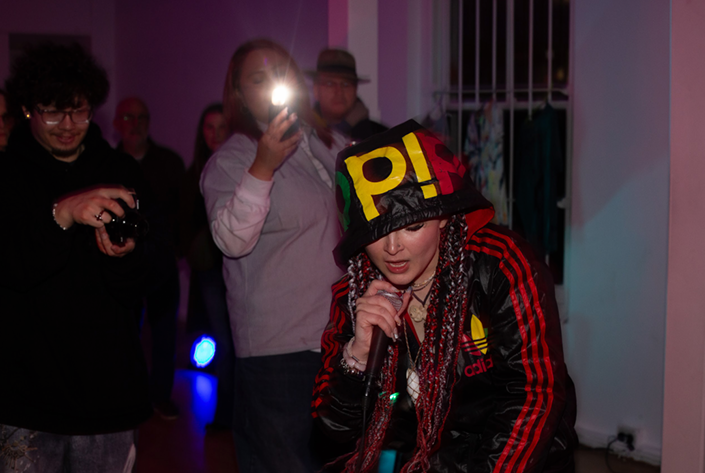
Midway through last year, I started playing gigs with my band, Masc/Femme. I was part of many one-off bands in university that formed for out-of-uni gig assignments, so the idea of stability in a band lineup was new. Three years ago, I was also part of another, more significant band, which has since dissolved due to an internal conflict that has deeply impacted my relationship with performing music and working with other musicians. After that exceedingly negative experience, I was convinced the only way I could go at it was solo. It pushed me in the opposite direction of where I needed to go; to be closer to my craft, I needed to invite another into the process, and in return, become privy to theirs. It’s a vulnerable and intimate thing. It is understanding the emotional landscape of a person, and in turn, deepening your perception of the world, which makes one more capable of capturing the profound. I met its members in unexpectedly interconnected ways, the lines converging at the University of Auckland’s philosophy club and at local gigs I attended alone at venues like Dead Witch and Whammy Bar. We started gigging last May, and through that, I have found genuine, deeply moving connections with musicians and adjacents in the local scene that have fundamentally changed me. Words are too frail a vessel to contain everything I feel about this, and I often sense that the enormity of my gratitude for what I have now is too much to process all at once. It will require years of quietude to internalize and properly understand that I, even as an outsider, fully deserve everything beautiful that has chosen to come my way and stick around. The music and its people have saved me again and again, and propelled me further than I ever believed I could go. And there is so much further I could go. What I have now is entirely worth the painful loneliness that preceded it, though a sense of separation remains.
To be known is to be loved. I have people back home who know who I’ve been most of my life, and here, a precious few who simply know me presently. I cannot reconcile my history and present self all at once with the people I love in both places, and though it’s something that evolves with the accumulation of time, it is, at first, a very long season of isolation. I am learning that alienation is not a transient thing, not a short-lived experience - it stays with you, well after the initial shock, as something deceptively inconsequential. Every compromise and encounter is a drop that makes an ocean, given enough time. I have spent so long trying to forget all the little things that still get to me that I have entirely forgotten how to retrieve and absolve them. But it has always been a bearable consequence of the gift of being able to grow into a space on my own, and to find people who reflect that joy. To know that belonging does not mean we all have to be the same. In a revelatory conversation with a friend of a friend, she told me that Southeast Asia is really an amalgamation of heritage, home to many looking for a home. The roots of our immigrant ancestors were already shallow in the land we were born on. It is our innate instinct to seek belonging, and though it will be lonely for a little while, we are pioneers for others like us to come.


Comments