
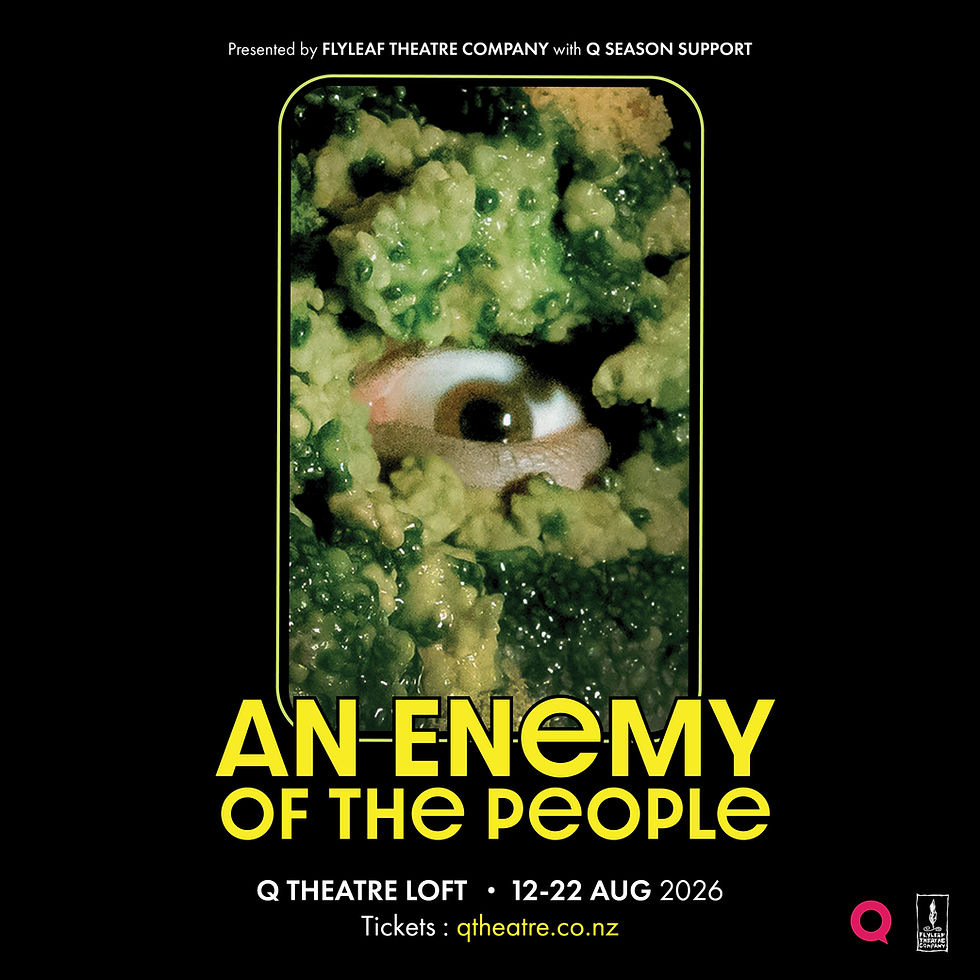
Review: An Enemy of the People

Updated: Aug 13
REVIEW | WEB EXCLUSIVE
Written by Tashi Donnelly (she/her) | @tashi_rd | Editor

Ahead of opening night, I caught up with director Grace Augustine to talk about reimagining Henrik Ibsen’s An Enemy of the People for present-day Aotearoa. You can read that interview here. She told me the production was motivated in part by increasing nitrate contamination in our freshwater, and by a desire to create political theatre that asks audiences to think critically about the systems governing our lives. She hoped audiences would leave asking themselves how far they would go “in the pursuit of truth and goodness”.
After seeing the production, I think that question is impossible to avoid.
A beautiful karanga welcomed the audience into Q Theatre’s Loft Theatre, setting the tone for this distinctly Aotearoa adaptation of Henrik Ibsen’s An Enemy of the People. Newly adapted by Aaron Richardson and relocated from nineteenth-century Norway to present-day Aotearoa, the production follows Dr Thomas Stockmann (Fraser Hoffman), a medical officer at the newly opened eco-spa Te Wai Puia. When Stockmann discovers the spa’s water has been contaminated, he expects his community — particularly his brother, the mayor (Sam Bunkall) — to support him in exposing the problem.
They don’t.

An Enemy of the People is as entertaining as it is thought-provoking. I wouldn’t have expected such a strong parallel between a nineteenth-century Norwegian public bath and a contemporary Kiwi eco-spa, but the setting is almost beside the point. This story could be set on Mars, and so long as humans are the stars and capitalism still exists, its central conflict would remain.
But An Enemy of the People isn’t just a critique of capitalism. It’s a brutally honest and psychologically devastating depiction of human frailty. It was genuinely stomach-turning to watch the narrative unfold, largely because its archetypal characters feel startlingly real without ever becoming caricatures. The performances make their compromises feel understandable, even when they are horrifying. Grace Cullen is particularly compelling as Katherine, Stockmann’s wife, whose priorities shift as the consequences of his crusade become increasingly personal.

The production’s most uncomfortable trick is how easily everyone changes tune. Characters who initially support Stockmann suddenly turn against him once they understand what telling the truth might cost them. The play explicitly invokes gaslighting, and the irony is difficult to miss: Stockmann is systematically discredited until he is forced to question not only how others see him, but how he sees himself.
There are no cartoonishly evil villains here, just ordinary people — which is arguably more terrifying. Their motives are painfully understandable. Katherine reduces the argument to its most basic material reality: money puts a roof over their heads and food in their bellies. It is difficult to condemn someone for prioritising their family’s immediate needs when the alternative is an abstract promise about the environment their children might inherit. The problem is not simply that everyone is greedy. It is that everyone has something to lose.
A crucial and climactic scene takes place at a town meeting, where the audience is invited to cheer or jeer at the characters’ speeches. Expertly played, the scene turns us into participants, pulling us from one side to the other and encouraging us to judge, condemn and choose. Slowly, uncomfortably, the production reveals what choosing sides actually does. In this scene, the cost of fixing the contamination, initially estimated at around $30 million, is inflated by the town's mayor to $100 million. Suddenly, clean water becomes an economic question. Who pays? Who loses their job? What happens to the town? Stockmann’s community essentially asks: why can’t you put us first?
When someone becomes the “enemy of the people”, how does that happen? Ultimately, it comes down to prioritising one thing over another: the environment your baby will grow up in, or your baby right now. Truth, or economic security. The collective good, or the people you love.
That is what makes Flyleaf’s An Enemy of the People so effective. Every decision feels predictable, yet no less shocking to watch unfold, perhaps because the choices these characters make are choices we recognise. The play didn't leave me comfortably believing I would have been on Stockmann’s side. It made me wonder how long I would have stayed there.
You will leave this play simultaneously speechless and full of opinions, and, for a play about the danger of speaking uncomfortable truths, that feels like exactly the right ending.
An Enemy of the People runs at Q Theatre, Auckland, until 22 August.
If you'd like to catch the show, Flyleaf Theatre Company will be hosting a Choose What You Pay performance on Thursday 13 August at 7:30 pm. With tickets available on a sliding scale from $15, audiences can choose a price that works for them while supporting independent theatre.


Geometry Game turns simple controls into an engaging test of timing, focus, and coordination. The gameplay centers on guiding a geometric character through energetic environments filled with obstacles, platforms, gaps, and perfectly timed challenges.