
Queer Artist's Tree #1: Avian Exile (A.V Des Forges)

INTERVIEW | QUEER ARTIST'S TREE | ISSUE FIVE | PUORO O AOTEAROA / LOCAL MUSIC
Interview by Maebh McCurdy (she/her) | @leighapparently | Trans Music Aotearoa
Interview with A.V Des Forges (she/her) | @vraikalzre | Musician, producer, & animator

Welcome to the first edition of Queer Artists’ Tree. A column where I sit in a tree (not really) with a queer artist based in Tāmaki Makaurau and talk to them about their craft, and how their queerness interacts with their artistry. This week, I sat in the boughs of a 3-kilometre-tall pōhutukawa tree with musician, producer, & animator, A.V Des Forges, AKA Avian Exile.
Maebh: First off, how’s the wind?
A.V: Almost blowing me away, but I’ve got a good grip on the branches.
Maebh: Introduce yourself!
A.V: My artist name is Avian Exile. A.V is my first and middle name initials, and is how I’d prefer to be known professionally.
I’ve recently tried to put my work out there in the public eye, which I’ve been hesitant to do for quite a while due to general shyness issues, but I made it my New Year’s resolution to actually start doing stuff because I knew I would have to eventually. I can’t just keep all my art in this vault underwater that no one will see for like a thousand years. Will they understand English?
Maebh: I guess that’s partly the benefit of ambient instrumental music
A.V: Yeah, though I am planning to do lyrics when I learn how to sing better. I think vocal dysphoria has held that back somewhat.
Maebh: You have a Master's degree in design?
A.V: I got my Bachelor's in Animation at Yoobee, and then at AUT for my Master’s my supervisor was Welby Ings. A famous queer filmmaker in New Zealand. He made a really good movie called Punch in which a gay teenage boxer falls in love with a takatāpui teenager. He really tries to pull no punches and not play it safe in terms of queer representation. He’s a veteran in the queer movements, so he really knows his stuff. He’s really articulate, very empathetic. Perfect balance of strict, but also caring as well. He was an excellent supervisor who really pushed me and my ideas forward to where they were naturally progressing.
A.V’s Capstone film, “Scripted Infection”
Maebh: What’s your music like?
A.V: In its primordial stage at the moment, but it’s primarily electronic modular synth music created using a virtual modular synth software called VCV Rack. It’s a bunch of different patches, building your own sound from the ground up. Sequencing some beats; playing them on your [laptop] keyboard; or through an actual keyboard, so I can articulate a bit more human.
What I really like about electronic music is the versatility. It’s a similar feeling I have towards animation when you compare it to live action. You get full control over the soundscape, and you can do anything with it; in theory, you can create any sound imaginable.
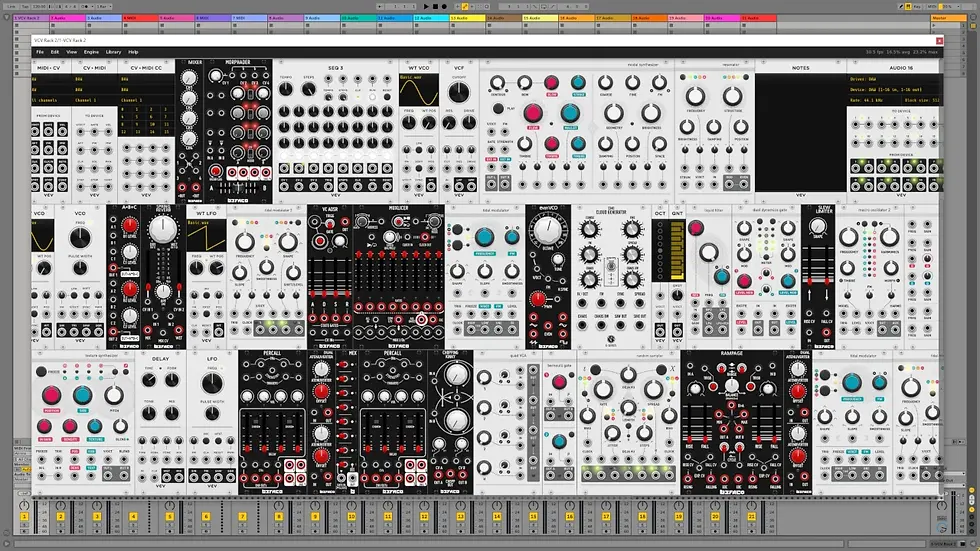
Image source: vcvrack.com
Maebh: Animation & music also pair very well together, which you’ve done in your capstone and master's projects.
A.V: Electronic music is the auditory equivalent of animation. It’s all from the ground up, there are no live-action instruments. I’m inspired very much by the works of SOPHIE; she has similar feelings about electronic music in terms of the stuff you can do with it versus the stuff we’ve seen with it in the mainstream.
A trans-femme musician who’s been a really big inspiration for me is Patricia Taxxon. Super complex melodies & rhythms, she knows her music theory. It’s almost high art electronic music. It feels very human, very emotional, but extremely tactile, especially in her more recent albums, where it feels like the percussion is just ringing in your ears and is hitting and whacking and flying all over the place.
One of my biggest inspirations ever is a band called Autechre. Two guys from Manchester who started making electronic music in the 90s. It feels like you’re staring into this other dimension where there’s all these little bits and pieces that feel alive, slowly shifting and evolving in a subtle way over time. It hooks your interest; their idiosyncratic beat switches especially.
Maebh: Do you have a theory on the monolithic trans-femme love for harsh and experimental electronics? I definitely fall into the stereotype.
A.V: I’ve been into electronic music as far back as I can remember, before I knew I was trans. I feel like the tactile intensity of transfem music speaks to the cerebral experiences that we have in our brains. We’re trying to give it a name, take it apart through music. And a lot of times, trans women tend to be more accepted in musical spaces compared to film spaces.
Maebh: What are your goals with your music and animation?
A.V: Making my own films, soundtracking them. Surrealist sci-fi fantasy that doesn’t have any humans in it, all mostly alien furry-esque creatures. Have the environments take full advantage of the medium of animation in terms of perspective, how abstract they can be, how dreamlike they can be. I really want to make fully alien societies with their own technology and unique culture and language that’s far removed from our own. Have the characters have their own complex philosophies, and arguments, the complexities of the ethics of situations in the plot. I definitely also want to make characters that are trans allegories. I had this idea of this character who’s an alien and they become this different species because they’re the reincarnation of this warlord and they realise they have to take up this responsibility because of who they are internally versus their external self, and they know that when they become this person it’ll be their soul being fulfilled. There’ll definitely be a lot of gender-fluidity in the worldbuilding.
Maebh: You’ve just released an album called My Cerebrum, what song should people check out from it?
A.V: Probably Metaphysical Yearning. It’s a more accessible listen compared to the other ones. It’s the one I was most proud of in terms of the melodies and the simple yet effective structure to it. I was basically performing it while I was recording it. There was a quantizer I used, switching the offset to different keys in real time. That’s why there’s slight modulations when each key is played, hopefully that’s the charm of it.
Maebh: My version of electronic music is the opposite of yours. I really enjoy taking the analogue or acoustic instruments and turning them into something electronic using the process to make them sound like synths.
A.V: Definitely the opposite because I want to do more physical modelling with my music, where I’m adding layers upon layers of electronic sound and noise or whatever to a timbre and making sound like it’s a physical object in a hypothetical 3D space. And this physical object could be something alien, like an instrument from an alien culture or it could be an entire mech that’s doing the percussion. And it’s stomping and pummeling through the mix and shaking everything up. In terms of that cinematic appeal, I’ve thought I’d love to make a drum break sound like a swordfight.
Maebh: People often call animation a genre instead of a medium, electronic music is the same. It’s a way of making music, a medium of creating sounds, not a genre.
A.V: Electronic music has a lot of potential that is yet to be harvested. The stars are the limit. People think that it has no soul and it’s pure artifice, but that depends on the person who uses it.
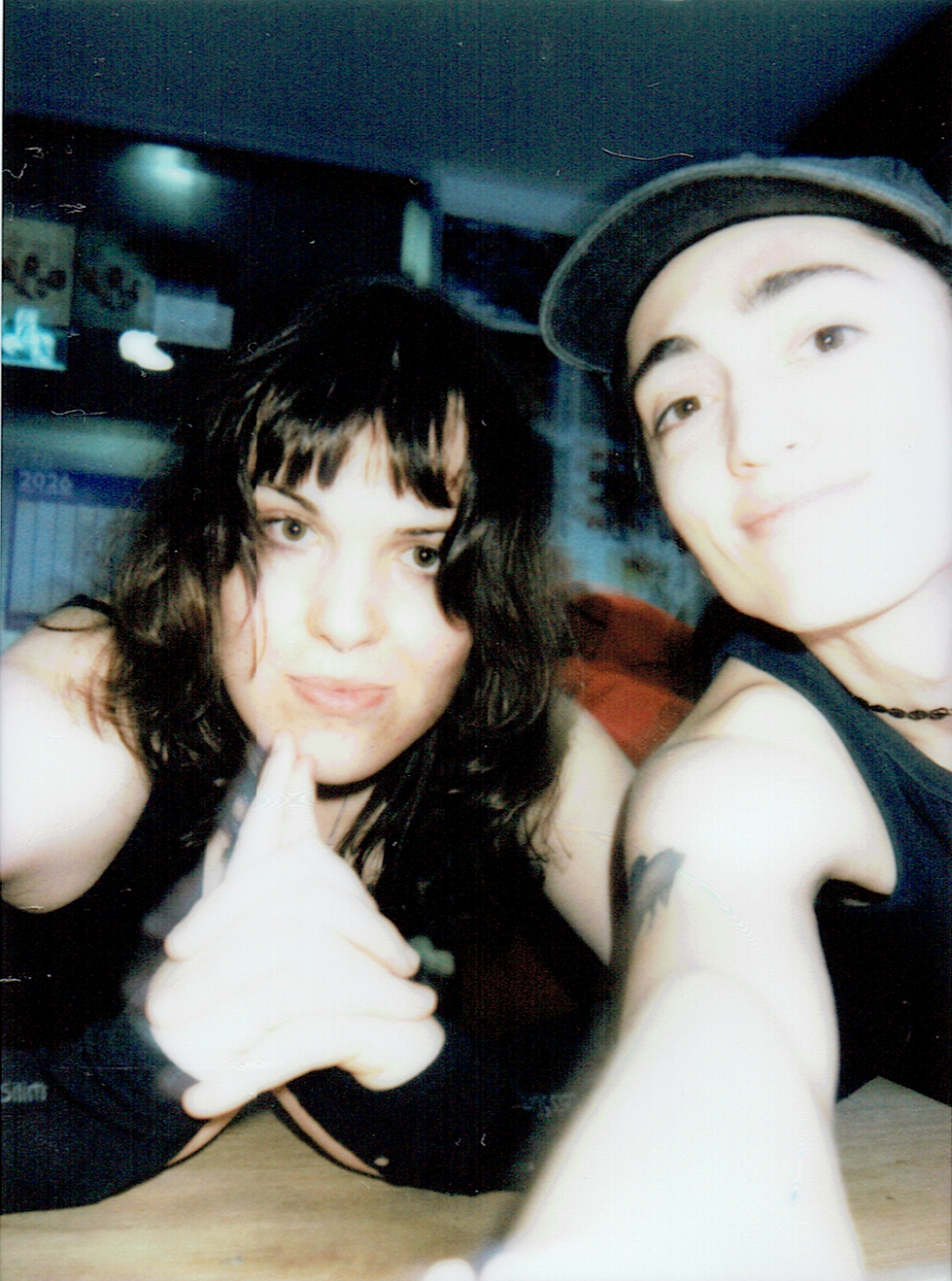
Polaroid selfie of A.V & Maebh in the Debate Office


Comments