
Kōrero Toi: Danielle Chen
KŌRERO TOI | ISSUE TWELVE | NOSTALGIA
Written by Danielle Chen (she/they) | @Dermillion | Contributing Artists
My artistic practice explores the second-hand nostalgia I feel for my father’s vibrant juvenile past in Taiwan, and my longing for his youthful experiences there. I researched 20th-century Taiwanese masculine youth and pop culture, combining it with my interpretation of my father’s life during that period. This is how I’ve created a romanticised and partially fictionalised portrayal of his adolescence. Based on his belongings, karaoke picks and the stories he has graced me with over time, I began to create a sort of narrative that explores my father’s individuality, showcasing a fraction of his generation’s experience.
The era’s influences were all heavily characterised by the post-martial-law burgeoning freedom and accompanied by rapid cultural-societal changes. Living through this transitional period as a teenager, my father had formed personal connections to the media and culture as they were contemporaneously emerging around him.
The End of Love (1996) original album cover, featuring Taiwanese artist Wu Bai, is visually altered to depict my father. This painting honours the album’s iconic status as a go-to karaoke classic growing up within my home, as well as exemplifying the aforementioned “second-hand nostalgia.” Music transmitted from one generation to another shapes autobiographical memories, preferences, and emotional responses. For me, the nostalgia attached to this album I depict is inherited from my father, hence the “second-hand” nature of it, as opposed to a first-hand one. This leaves me having to accept that no matter how much I appreciate the album, I will never be able to experience it during its contemporary peak in the same way that my father and his generation did.
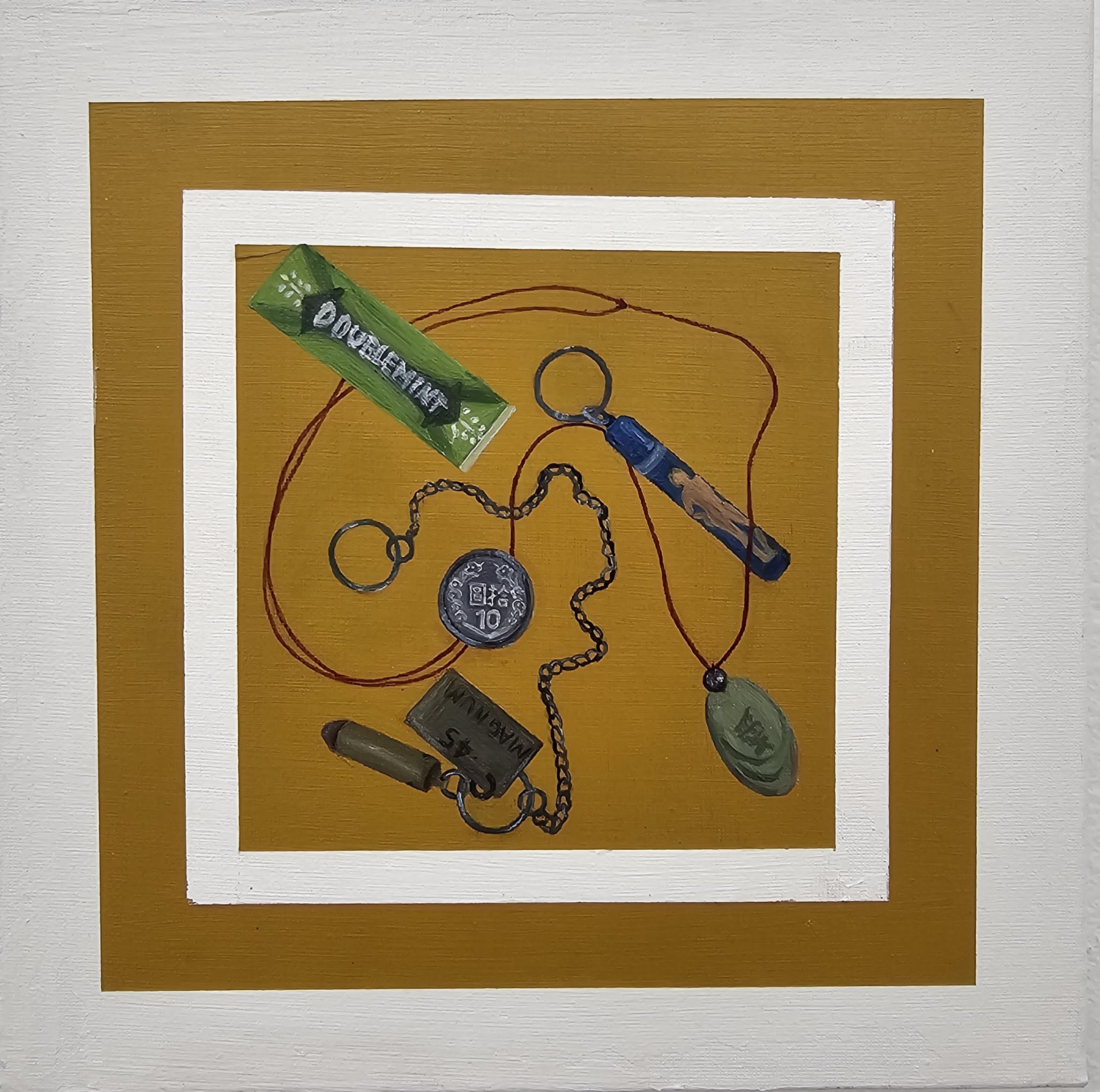
Fewer restrictions, less surveillance, and other social changes of post-martial-law Taiwan contributed to an emerging juvenile identity centred around masculinity, delinquency, and self-expression. Alongside my father’s stories and possessions, this context has shaped my perception of his experiences and participation in the masculine youth culture of the time. Both seemed to offer him forms of exhilaration and challenges that I long for and romanticise, yet could never experience myself. Miscellaneous belongings from his school days are painted scattered across a platter of warm ochre. Items such as a bullet-chain accessory, alongside a keychain of a nude woman, illustrate carefreeness, a sense of rebellion and performed masculinity.
The melancholic longing for a past I have never lived was built on these; it is nostalgia by association, never could it be first-hand. As a second-generation Kiwi Asian, I yearn for the nostalgia of an era I haven’t experienced personally. I feel certain that this fondness for something that transcends time and place is shared by many young people today who have similar circumstances to mine.
By painting stories and possessions, I delve into a history that remains both influential and unfamiliar, in hopes of capturing the essence of a past that continues to shape and inspire my understanding of both my father and myself today.


Comments