
Rick’s Reel Recommendations | 3 Films for 3 NZ Lyrics
COLUMN | ISSUE FIVE | PUORO O AOTEAROA / LOCAL MUSIC
Written by Ricky Lai (he/him) | @rickthelai on IG & Letterboxd | Columnist
Music and movies pair together like Marlborough wine and Eltham cheese. For this issue’s film column, I’ve plucked out three song lyrics from present-day Aotearoa and partnered them with films that, to me, evoke those words.

Yojimbo (Akira Kurosawa, 1961)
Song: Avantdale Bowling Club, Friday Night @ The Liquor Store (2022)
The lyric: “The best of West Auckland's worst combined forces,
Of workhorses horsed on state house porches,
Gather like mourners to farewell the fallen,
Dreams of old washed-up fiends and broke ballers.”
I apologise to any Westies reading this, who won’t be flattered by the hacky connection I’ve drawn between their home suburbs and the village-turned-smoking-warzone at the end of Yojimbo. But listen to Tom Scott’s darkly comic, apocalyptic lyric of a post-Covid stint at a local bottle shop, then see if you can draw parallels between these two cinematic tales of drunken chaos. Given that Kurosawa’s film revises the genre trope of a travelling cowboy, Scott’s choice to anchor ‘Friday Night @ the Liquor Store’ in the West is a kinship not lost on me either. In one breath, Yojimbo, titled after the Japanese word for ‘bodyguard’, is an explosive tale of how a swordsman can get by in the age of gunpowder. The other breath is told by his cynical method. The rōnin drifts into a town whose lucrative trade of pleasures such as sake, silk, and gambling has left it split apart by corruption and greed. For the traveller, he offers his service as a yojimbo to two rival gangs, gaming them into eventually destroying each other (and nearly himself in the process). A charcoal haze steeped in rice wine and gunsmoke obscures the economic potential of what might have been of this town. By dawn, the madhouse collapses, and the rōnin flees by the skin of his teeth. You come away with an inkling that economic collapse befell marginal communities that cannot be redeemed by independent, vigilante agents. You also come away thinking about one of the funniest sight gags to demonstrate how fucked-up this town is: a dog with a severed hand clamped in its jaws. Not only was this joke borrowed by Eurotrip in 2004, but it’s also a nasty little metaphor for a pool of bodies devouring itself.
3 Women (Robert Altman, 1977)
Song: Psycho Gab, Compass (2026)
The lyric: “I'll come back in time / It must be my design,
I'll meet you in the middle / Reintroduce myself.”
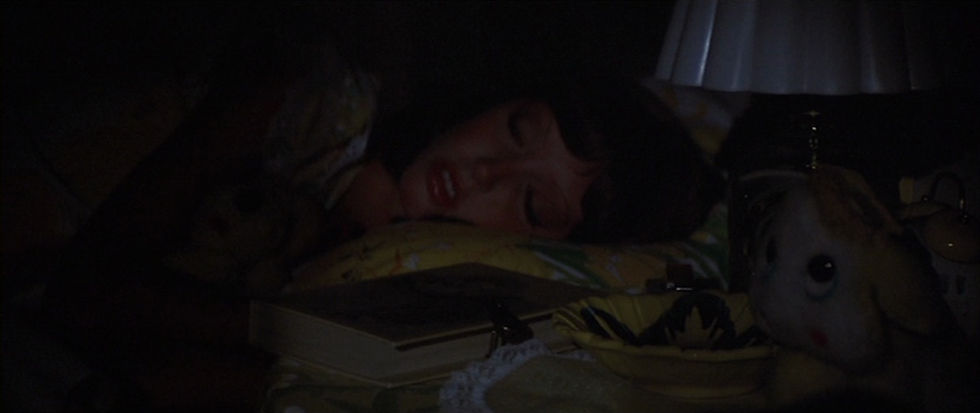
No matter how benign and charming you find Shelley Duvall (and you should), it doesn’t matter how happily you’d listen to her boast for hours about her town-renowned dinner parties or exotic hula dancers at Macy’s; in 3 Women, her co-workers at the elderly health spa don’t want to hear it. As Millie the chatterbox (Duvall) yaps on and on, usually to nobody in particular, you can faintly hear her peers pull mean-spirited impressions of her. It’s up to us to sift through that foliage of voices. Because we tend to ‘lose’ Duvall in a scene, it’s worth considering that we are not occupying her perspective but rather an all-encompassing, topological bird’s eye view, clouding all identities into one universal frequency. In fact, when rosy, doe-eyed girl’s-girl Pinky (Sissy Spacek) floats into Millie’s orbit, the two are friendly enough to become roommates, but Millie is so vain that she takes her ride-or-die for granted. After a near-tragedy involving a large height and a swimming pool ruptures their bond for good, something unbelievable happens: the two seem to swap personalities. From here on out, the encroaching nightmare silting under the nails of 3 Women reveals itself like a procession of ghosts at the foot of Scrooge’s bed. A bizarre sensory experience that, at this point in time, seems to be about the act of saying anything, out of fear that you’ll become nothing.

Cockaboody (John & Faith Hubley, 1974)
Song: The Beths, Metal (2025)
The lyric: “I’m a collaboration / Bacteria, carbon and light,
A florid orchestration / A recipe of fortune and time.”
And I leave you with a whizzing flashbang of chemicals. Eight minutes on YouTube, waiting for you. If you ever need something gentle to wind down with in the late evening, load it up and come back to your young self. Married animators John and Faith Hubley (parents to Georgia Hubley from indie rock band Yo La Tengo!) believe so earnestly in the anarchic capability of the child’s imagination. While Cockaboody is simply one of their shorts (and not even one of their Academy Award-nominated ones), it’s also perhaps their best. Last year, a wonderful vignette from their feature-length film Everybody Rides the Carousel (1976) went viral on Instagram, in which two adult lovebirds in a rowboat venture out into the middle of a lake, shape-shifting back into their adolescent selves with every renewed experience. Spotting a duck, flinching at a splinter. One should see this reflecting how the Hubleys’ nurture their own inner child in their art. Cockaboody is a gleefully surreal adventure through the child’s eye in the safety of their parent’s home, voiced by the Hubleys’ preschool-age children as they babble on about nothing. On the rich, warmly textured backgrounds, the kids are rendered instead like paper-white blobs distinguished by pencil-thin outlines. They are like splotches of canvas yet to be painted over. So many beautiful sights, like the slight shake of the chair when one of them sneezes. Or the passing back and forth of a cup between sips of water. Or briefly transmuting into a dog, visible by just the peeking snout from under a blanket. Linus and Lucy got nothin’.


Once you have a few confirmed letters, dordle start looking for possible word patterns. And with limited guesses, there’s no time to waste.